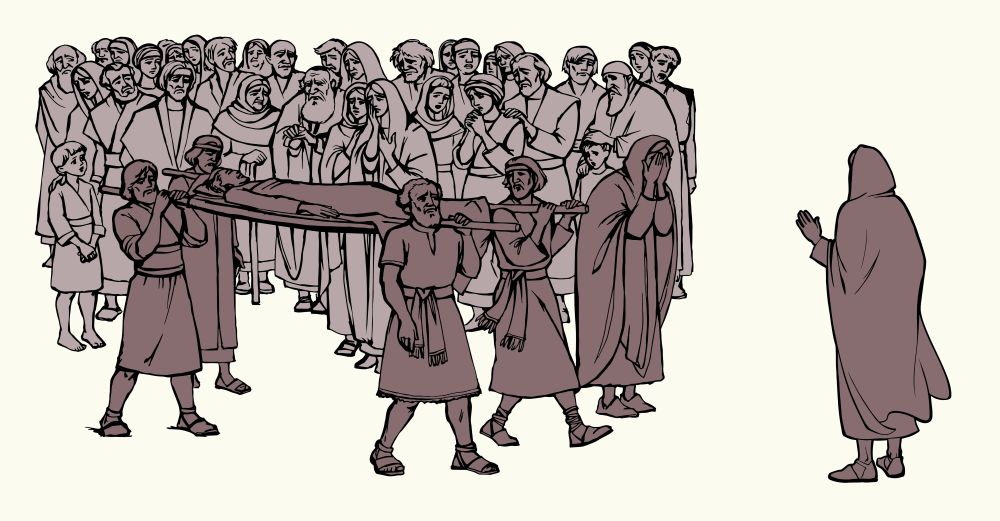
But in Luke 7:11–18, we see something extraordinary: death is interrupted. A funeral procession is stopped. A grieving mother’s tears are answered. And Jesus demonstrates that He does not just comfort in death—He commands it.
This passage reveals that when Jesus shows up, death no longer has any authority.
I. Death Had Taken Everything (vv. 11–12)
“And, behold, there was a dead man carried out, the only son of his mother, and she was a widow…”
This woman had lost everything:
-
She had lost her husband
-
Now she had lost her only son
-
She had lost her future, her protection, her provision and all hope.
This is not just a funeral—it is a life sentence of grief.
Death does not discriminate. It takes the young and the old. It enters homes uninvited. And when death shows up, it often leaves emptiness behind.
But notice this:
- Jesus meets her at the city gate—the place of transition between life and burial.
Truth: Jesus often meets us at our breaking point, right where hope seems to end.
II. Compassion Moved the Lord (v. 13)
“And when the Lord saw her, he had compassion on her, and said unto her, Weep not.”
Jesus was not invited. The widow never asked Him raise her son from the dead. There were no previous prayer request.
But Jesus saw her.
The text calls Him “the Lord,” reminding us that His compassion flows from His authority.
-
He didn’t say, “I understand.”
-
He didn’t say, “Time will heal.”
-
He said, “Weep not.”
Only someone with power to change the situation can command sorrow to stop.
Truth: Jesus’ compassion is not passive—it is powerful.
III. Jesus Confronted Death Directly (v. 14)
“And he came and touched the bier: and they that bare him stood still.”
As a Nazarite, Jesus was forbidden to touch anything dead. But when Jesus touches the thing that carried death, death had to release his captive.
He overrules it.
Everything stopped when Jesus touched the coffin:
-
The pallbearers stopped
-
The procession stopped
-
Everyone and every thing had to pause.
Then Jesus speaks:
“Young man, I say unto thee, Arise.”
He didn’t pray.
He didn’t ask permission.
He commanded life.
Truth: Death listens when Jesus speaks.
IV. Life Obeyed the Voice of Christ (v. 15)
“And he that was dead sat up, and began to speak.”
This was not symbolic.
This was not spiritual only.
This was physical resurrection.
The same mouth death silenced began to speak again.
The same body death claimed responded to Christ’s voice.
Then the Bible says:
“And he delivered him to his mother.”
Jesus not only restores life—He restores relationships, hope, and future.
Truth: What death takes, Jesus has the power to return.
V. The Crowd Recognized Divine Authority (vv. 16–18)
“There came a fear on all: and they glorified God…”
They declared:
-
“A great prophet is risen up among us”
-
“God hath visited his people”
They realized this was more than a miracle—this was divine visitation.
This miracle pointed forward to:
-
Jesus’ own resurrection
-
His victory over the grave
-
His declaration: “I am the resurrection, and the life” (John 11:25)
Truth: Jesus does not borrow life—He is life.
VI. What This Means for Us Today
-
Jesus has power over physical death
Every grave will eventually hear His voice. -
Jesus has power over spiritual death
Dead dreams. Dead faith. Dead hope. Dead souls. -
Jesus has power over eternal death
Because He rose, we can rise.
“O death, where is thy sting? O grave, where is thy victory?”
—1 Corinthians 15:55
Conclusion
At Nain, two processions met:
-
One carried death
-
One carried life
And when they met, life prevailed.
If Jesus can stop a funeral procession,
If He can speak to a corpse,
If He can reverse death itself—
Then there is nothing in your life beyond His authority.
Jesus has power over death—
and because He lives, we shall live also.